Sangeh Monkey Forest: Incredible Bali Adventure
I’ll admit, I was skeptical. After spending a few days in Bali, you start to feel like every travel brochure is shoving the same five destinations down your throat. Everyone talks about the Monkey Forest in Ubud. But my driver, Made, insisted there was another spot—one older, quieter, and filled with towering nutmeg trees.
Escape the Crowds: My Afternoon at Sangeh Monkey Forest
So, I found myself bumping along a road north of Denpasar, heading toward the village of Sangeh. I wasn’t expecting much, maybe just a quick stop to stretch my legs. But as soon as I stepped through the stone archway, the atmosphere shifted. It felt heavy, ancient, and distinctly wild.
If you are tired of the selfie sticks and the chaos of Ubud, this might be the jungle escape you are looking for.
Walking Among the Giants
The first thing that hits you at Sangeh is the scale of the trees. We aren’t talking about your average palm trees here. This is a dense forest of Pala trees—nutmeg trees—that soar up to 40 meters high.
The air felt cooler under that thick canopy. It smelled incredible, a mix of damp earth, moss, and this faint, spicy scent from the nutmeg hanging in the air. Sunlight struggled to poke through the leaves, dappling the forest floor in patches of harsh light and deep shadow.
I walked along the paved path, the sounds of the busy Bali highways fading away, replaced by the rustle of high branches and the distant call of birds. It felt like stepping back in time. The roots of these giants snaked across the ground, twisting over the ancient mossy stones like pythons.
The Locals: Meet the Macaques
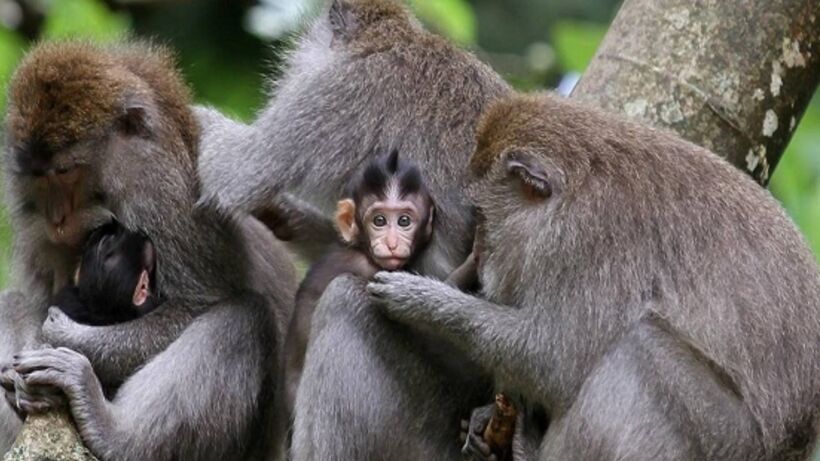
Of course, the trees aren’t the only residents here. Sangeh is home to a large tribe of Balinese long-tailed macaques. I had braced myself for aggression, having heard horror stories about monkeys stealing sunglasses and biting ankles in other parts of the island.
Honestly? They were intense, but fascinating.
As I walked deeper, I saw them high above, leaping effortlessly from branch to branch. They look a bit different from the Ubud monkeys; their fur seems thicker, perhaps a bit greyer. They were definitely watching me.
The Peanut Heist
There are locals selling peanuts and bananas near the entrance. I bought a small bag of peanuts, mostly because I wanted to see what would happen. Big mistake? Maybe.
A large male dropped down from a tree about ten feet away. He didn’t run at me. He just walked. He had this calm, swaggering confidence that was honestly intimidating. He stopped right at my feet, looked me in the eye, and held out his hand.
I dropped a peanut. He cracked it open and ate it, never breaking eye contact. Then, a younger one tried to sneak up behind me. My guide shooed him away with a stick, but I felt my heart rate spike. It’s a weird mix of fear and exhilaration, being that close to a wild animal that clearly weighs more than my toddler niece.
Pro tip: If you go, keep your snacks zipped away tight. I saw a guy lose a bag of chips in about three seconds flat.
The Mossy Temple: Pura Bukit Sari
In the middle of this nutmeg jungle, there is a temple. It’s called Pura Bukit Sari, and it dates back to the 17th century.
It’s strikingly different from the shiny, open temples you see in the south. This place feels reclaimed by the forest. The stone carvings are covered in thick, green moss and lichen. The moisture in the air here makes everything feel slick and alive.
I wandered around the outer courtyard. You can’t go inside the inner sanctum unless you are there to pray, which I actually appreciated. It felt respectful. I saw a few Balinese locals making offerings, the scent of burning incense mixing with the nutmeg smell.
There are these giant stone statues of Garuda (the mythical bird) and other guardians covered in black and white checkered cloths. Seeing them half-hidden in the shadows of the massive trees gave the place a slightly mystical, slightly spooky vibe. It wasn’t “tourist spooky”—it was genuinely atmospheric.
Planning Your Trip to Sangeh
I really enjoyed my afternoon here, but it’s not the kind of place you need to dedicate a whole day to. It’s perfect for a half-day trip if you are staying in the south or near Ubud.
Getting There
I hired a private driver for the day, which I highly recommend if you want to combine this with other spots like the Taman Ayun Temple (which is relatively close).
- From Kuta/Seminyak: It took me about 45 to 50 minutes to get there, depending heavily on traffic. The road gets narrow and winding as you get closer to Sangeh.
- From Ubud: It’s roughly a 30 to 40-minute drive.
- From Canggu: Count on at least an hour to an hour and fifteen minutes.
Costs and Tickets
The entrance fee is very reasonable compared to some of the big-name attractions in Bali.
- Foreign Adult Ticket: Expect to pay around 50,000 IDR (about $3.50 USD).
- Parking: If you are driving a scooter or car, parking is extra, usually just a few thousand Rupiah paid to the parking attendants.
You can also rent a sarong if you aren’t wearing one, though it’s always polite to have your own if you plan on visiting multiple temples.
Opening Hours
The sanctuary is usually open daily from 7:30 AM to 6:00 PM.
I visited around 2:00 PM. It was quiet, but the light was a bit low in the forest. If you want good photos, aim for the morning. The light filtering through the nutmeg trees in the early morning mist would be magical.
The Verdict: Is Sangeh Worth It?
I liked Sangeh more than I expected to. It’s not as polished or as manicured as the Ubud Monkey Forest. It feels rawer.
If you are looking for a pristine tourist park with smooth paths and cafes, you might be disappointed. But if you want to stand underneath a 50-meter nutmeg tree, breathe in spicy air, and see a temple that looks like it’s been sleeping for a hundred years, this is the spot.
Just keep a firm grip on your sunglasses and maybe skip the peanuts unless you’re ready to negotiate with a monkey mafia.