Pulau Siau: Ultimate Enchanting Tarsier Paradise
I’ve always been a sucker for islands that are a little hard to get to. You know the type—the ones that require a ferry schedule, a bit of patience, and a willingness to sweat. That’s exactly how I ended up on Pulau Siau, a jagged chunk of volcanic rock in North Sulawesi.
Chasing Ghosts in the Jungle: My Quest to Find Tarsiers on Pulau Siau
Most people flock to Bali or the Gili Islands, but I wanted something different. I’d heard stories about an island where the forests come alive at night with huge-eyed primates called tarsiers, where an active volcano smokes in the distance, and the tourists are few and far between.
It sounded perfect. It also sounded exhausting. Spoiler alert: it was both.
The Journey There: Not for the Faint of Heart
Getting to Siau is an adventure in itself. From Manado, you have to take a ferry. I won’t lie to you—the schedule can be confusing.
I spent a morning at the port, watching the chaotic ballet of cargo being loaded onto boats, smelling the thick scent of diesel and drying fish in the humid air. When the KM (ship name) finally docked, it was packed. I found a spot on the deck, claimed a plastic bench, and braced myself for the four-hour ride.
The ocean was rougher than I expected, spraying salt water over the rails. But as the silhouette of Siau grew on the horizon, dominated by the twin peaks of Mount Karangetang, I forgot about the seasickness. The island looks imposing. It rises straight out of the sea, green and steep and brooding.
Stepping Onto the Island
The heat hits you the moment you step off the boat. It’s a sticky, heavy tropical heat that clings to your clothes immediately.
I stayed in a simple homestay in the main town. Don’t expect luxury resorts here; we’re talking basic rooms with fans and mattresses that are a bit firmer than I’m used to. But the family running the place was incredibly welcoming, instantly offering me coffee and questioning me about where I was from in that lovely, curious way Indonesians have.
The Smell of Sulfur
One thing you can’t ignore on Siau is the smell. Depending on which way the wind blows, there’s a faint, sharp scent of sulfur in the air. It’s a constant reminder that Mount Karangetang is active. It’s one of Indonesia’s most active volcanoes, and it looms over everything you do here. It’s beautiful, sure, but it also commands a certain respect.
The Main Event: Meeting the Tarsiers
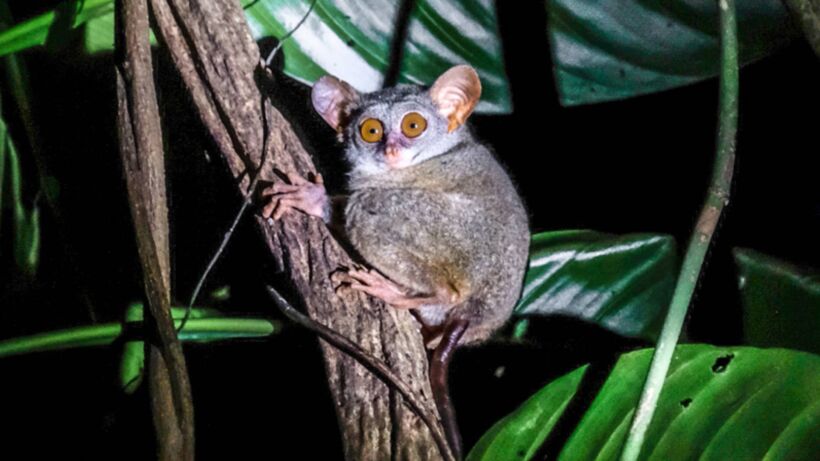
Let’s be real—I came for the Tarsiers. These are not your average zoo monkeys. The Siau Island Tarsier is a specific species found only here, and unfortunately, they’re critically endangered. Seeing one in the wild felt like a privilege I didn’t want to mess up.
I hired a local guide just before sunset. We hopped on the back of his motorbike and rode out of town, leaving the pavement behind for bumpy dirt tracks that cut through clove plantations and dense thickets.
Into the Forest at Dusk
As the light started to fade, the jungle noise changed. The cicadas started up their rhythmic screeching, and the air grew cooler.
We stopped near a patch of secondary forest and walked quietly into the undergrowth. My guide carried a small red light. He explained that white light blinds them, but red light they can tolerate.
We didn’t have to wait long. A sudden high-pitched chirp cut through the air. Then, I saw it.
Those Eyes
It was perched on a vertical branch, maybe three feet off the ground. The first thing that strikes you is the size of the eyes. They are massive, fixed orbs that seem to take up its entire face. It looked like a tiny alien mixed with a gremlin and a stuffed animal come to life.
I held my breath. The little creature was frozen, watching us. Then, in a blur of movement, it launched itself into the air, leaping meters to land silently on another tree.
We spent about an hour following a small family of them. It was magical, but also a little eerie. They move completely silently. If you didn’t know they were there, you’d walk right past them. Watching the mother carry a tiny baby on her back was a moment I won’t forget quickly.
Exploring Beyond the Jungle
During the day, when the tarsiers are sleeping, I explored a bit more of the island.
Waterfalls and Hot Springs
There are a few waterfalls on the island, but getting to them requires a bit of a trek. I hiked to one that cascaded down the volcanic rock. The water was cold and refreshing, a sharp contrast to the humid air.
Later, I soaked in a natural hot spring near the base of the volcano. It wasn’t a developed spa—just a rocky pool where the water bubbled up from the ground. Sitting there, surrounded by jungle, listening to the distant rumble of the volcano, was pretty surreal.
The Underwater World
I also squeezed in a snorkeling trip. The water around Siau is deep and drops off quickly. I saw some decent coral walls and plenty of colorful reef fish, though I wouldn’t put it in the same league as Raja Ampat or Bunaken. It was wild, though. The current was strong, reminding me that this is a raw, untamed part of the ocean.
The Reality Check: Is It Worth It?
I want to give you the honest truth, not just the glossy travel brochure version.
Pulau Siau is rugged. The infrastructure is limited. You won’t find smoothies bowls or co-working spaces here. The trash situation, like in many parts of Indonesia, is heartbreaking at times, seeing plastic washed up on what should be pristine beaches.
There were moments when I felt sticky, tired, and a bit out of my depth. The language barrier can be tricky if you don’t speak Bahasa Indonesia, and the food options are mostly limited to local warungs serving rice and fish (which was delicious, by the way, especially the rica-rica spicy sauce).
But if you are the type of traveler who values authentic interactions over comfort, it’s worth it. The thrill of seeing those tarsiers in their natural habitat, away from cages and crowds, outweighed the bumpy roads and the lack of AC.
Practical Tips for Visiting Pulau Siau
If you’re thinking of making the trip, here’s what you need to know to make it smoother than mine was.
Getting There
- By Sea: The main route is via the overnight ferry from Manado (bitung port) or fast boats from Tahuna. The KM ferries are the standard option. Check the current schedules locally because they change based on the weather. The trip costs around 100,000 – 150,000 IDR ($7-$10 USD) one way.
- By Air: There is a small airport on Siau (Ulu Siau Airport), but flights are notoriously unreliable and weather-dependent. Don’t bank on this unless you have a flexible schedule.
Where to Stay
There are a few “losmen” (guesthouses) and homestays in the main town (Ulu Siau) and near the beach. Don’t expect to book online easily. I usually just rock up and ask around, or have a contact in Manado call ahead. Prices are very cheap, usually around 150,000 – 250,000 IDR ($10-$17 USD) a night for a basic room.
Best Time to Go
The dry season (April to October) is your best bet. The seas are calmer for the ferry ride, and hiking is safer. Avoid the rainy season if you can, as the paths turn to mud and the volcano can be more active with rain causing lahars (mudflows).
Tarsier Spotting Etiquette
Please, please respect the animals. Do not touch them, do not use flash photography, and keep your voices down. I was disappointed to hear some guides in the area trying to lure them out with calls or food—find a guide who respects the “silent observation” rule. We are guests in their living room.
Money
Bring cash. There are ATMs on the island, but they are frequently empty or out of service. Indonesian Rupiah is king here.
Final Thoughts
Leaving Pulau Siau, I felt a strange mix of relief and nostalgia. I was ready for a soft mattress and a cold shower that didn’t smell like sulfur. But as the ferry pulled away and I watched the volcanic island shrink into the haze, I already missed the wildness of it.
It’s not a place for everyone. It’s dirty, loud, and chaotic. But if you look past the surface, you’ll find a place that feels genuinely alive. And those glowing eyes in the dark? That’s a memory that will stick with me for a long time.